Read Time: 11 min
A crash shakes your confidence, but driving away from a collision repair shop with incomplete or improper work can leave you less protected on your next drive. When your vehicle takes a front, rear, or side impact, the damage often goes well beyond dented sheet metal and scuffed paint. Modern vehicles are engineered around high-strength steel safety cages, carefully tuned crumple zones, and Advanced Driver Assistance Systems (ADAS) that react in fractions of a second.
If a shop focuses only on appearance and skips diagnostic scans, 3D frame measurement, or sensor calibration, your vehicle’s safety systems can be quietly compromised. Hidden structural damage and misaimed sensors don’t always show up on the dashboard.
In this guide, you’ll learn how modern safety structures work, how ADAS calibration is verified, and what paperwork to ask for at pickup.
TL;DR / Quick Summary
Proper collision repair restores your vehicle’s structure and its electronic safety systems, not just its appearance.
Key Takeaways:
- Many automakers prohibit heat-straightening ultra-high-strength and boron steel because heat permanently weakens it.
- A camera or radar aimed just 1 degree off is looking more than 5 feet to the side at 100 yards.
- Small aiming errors often don’t trigger a warning light, so a clean dashboard isn’t proof of calibration.
- Most automakers call for pre- and post-repair scans to catch hidden fault codes.
- Ask for frame measurement printouts and ADAS calibration reports when you pick up your vehicle.
How Modern Vehicles Protect You in a Crash

Modern vehicles don’t rely on rigid, heavy frames that pass crash energy straight to the people inside. Instead, engineers design specific sections of the body to collapse in a controlled sequence so the passenger compartment doesn’t have to.
Today’s unibodies combine crumple zones with Advanced High-Strength Steels (AHSS), hot-stamped boron steel, and structural aluminum. In a frontal impact, the front rails fold in a planned pattern, absorbing the hundreds of thousands of joules of energy a car carries at highway speed and routing the remaining force around the cabin.
At the center sits the passenger safety cage: the A-pillars, B-pillars, roof rails, and rocker panels. These parts are built to resist deformation in rollovers and side impacts. When crash damage reaches this cage, restoring it properly depends on following the automaker’s (OEM’s) published repair procedures.
How Improper Structural Repairs Weaken Your Vehicle
High-strength steel and aluminum require different equipment and training than older mild-steel vehicles. I-CAR, the collision industry’s main training organization, stresses following OEM repair information on every structural repair. Shortcuts here create weaknesses you can’t see, and they may not show up until the next crash.
Heat Straightening
Older repair methods used a torch to heat bent frame rails and pull them back into shape. On today’s ultra-high-strength and boron steels, that heat changes the metal’s microstructure and can permanently reduce its strength. That’s why many automakers prohibit heat straightening on these parts entirely and require replacement instead. An overheated rail may crack or collapse unpredictably in a future crash.
Sectioning in the Wrong Place
Automakers publish exactly where a structural rail or pillar can be cut and joined, and some parts can’t be sectioned at all. A cut in an unapproved location can change how crash energy travels through the structure.
Using the Wrong Joining Method
Modern vehicles are assembled with squeeze-type resistance spot welds (STRSW), self-piercing rivets, structural adhesives, and, on some models, MIG brazing with silicon bronze. Each automaker specifies which method goes where. Substituting a standard MIG weld where the OEM calls for something else can leave a heat-affected zone that’s weaker than the surrounding metal.
If your estimate doesn’t reference OEM repair procedures, you have no assurance the structure will perform the way it did in factory crash testing.
Why ADAS Calibration Matters After a Collision
Structural repair and electronic safety systems are tightly connected. ADAS features watch the road, help you steer, and can brake on their own. According to the IIHS, automatic emergency braking cuts police-reported rear-end crashes roughly in half, but only when its sensors are aimed correctly. These systems depend on several components:
- Forward-facing camera: Mounted behind the windshield near the rearview mirror; it powers lane keeping assist and traffic sign recognition.
- Front radar: Mounted behind the front bumper or grille emblem; it drives automatic emergency braking and adaptive cruise control.
- Rear corner radar: Mounted behind the rear bumper corners; it handles blind spot monitoring and rear cross-traffic alert.
- Ultrasonic parking sensors: Small round sensors in the bumpers for low-speed parking assist.
- Surround-view cameras: Mounted in the side mirrors, grille, and liftgate to create a 360-degree parking view.
NHTSA explains what each feature does.
How a 1-Degree Error Grows With Distance
These sensors are aimed relative to your vehicle’s thrust line, the direction the rear wheels actually push the car. If a bumper reinforcement or camera bracket goes back on slightly crooked, the aiming error grows steadily with distance.
At 10 feet, a 1-degree error shifts the sensor’s aim about 2 inches. At 100 yards, the same error puts it more than 5 feet off, which is enough to mistake a car in the next lane for one in yours. The result can be phantom braking or a system that’s slow to react to a stopped car ahead.
Why No Warning Light Doesn’t Mean You’re Safe
ADAS warnings typically come on for electrical faults, a disconnected sensor, or a view blocked by snow, mud, or road salt. Many systems can also flag a large misalignment, but a sensor that’s slightly off may keep operating on bad information with no warning at all. Confirming correct aim takes an OEM-level scan tool plus the calibration or aiming check the automaker specifies.
Static vs. Dynamic Calibration
Automakers specify one of two calibration methods, and some vehicles need both.
Static calibration happens inside the shop. The vehicle sits on a level floor, the technician measures its centerline and thrust line, and targets or radar reflectors are placed at the exact distances and heights the OEM specifies.
Dynamic calibration happens on the road. A technician drives the vehicle with a scan tool connected, usually at a steady speed on well-marked roads, until the camera or radar finishes learning. Rain, snow, heavy traffic, or faded lane lines can stop the process, which is a real factor during a Pennsylvania winter.
What You Can Handle vs. When to Call a Professional

Some checks are easy to do in your driveway. Others require shop equipment.
Tasks Most Vehicle Owners Can Do
- Check panel gaps: Look for even gaps around the hood, fenders, doors, and headlights. Uneven gaps can point to shifted structure underneath.
- Inspect the camera area: Make sure the windshield glass in front of the camera is free of chips, haze, and wiper streaks.
- Confirm driver-aid settings: Check your settings menu to make sure features like blind spot monitoring and forward collision warning are still turned on after the battery was disconnected.
Tasks for Confident DIYers
- Basic code reading: A retail OBD-II reader can confirm engine codes are cleared, but most basic readers can’t access ADAS, radar, or airbag modules.
- Sensor cleaning: Gently clean radar covers and camera lenses with a microfiber cloth and pH-neutral car wash soap to remove road salt and film.
When to Call a Professional
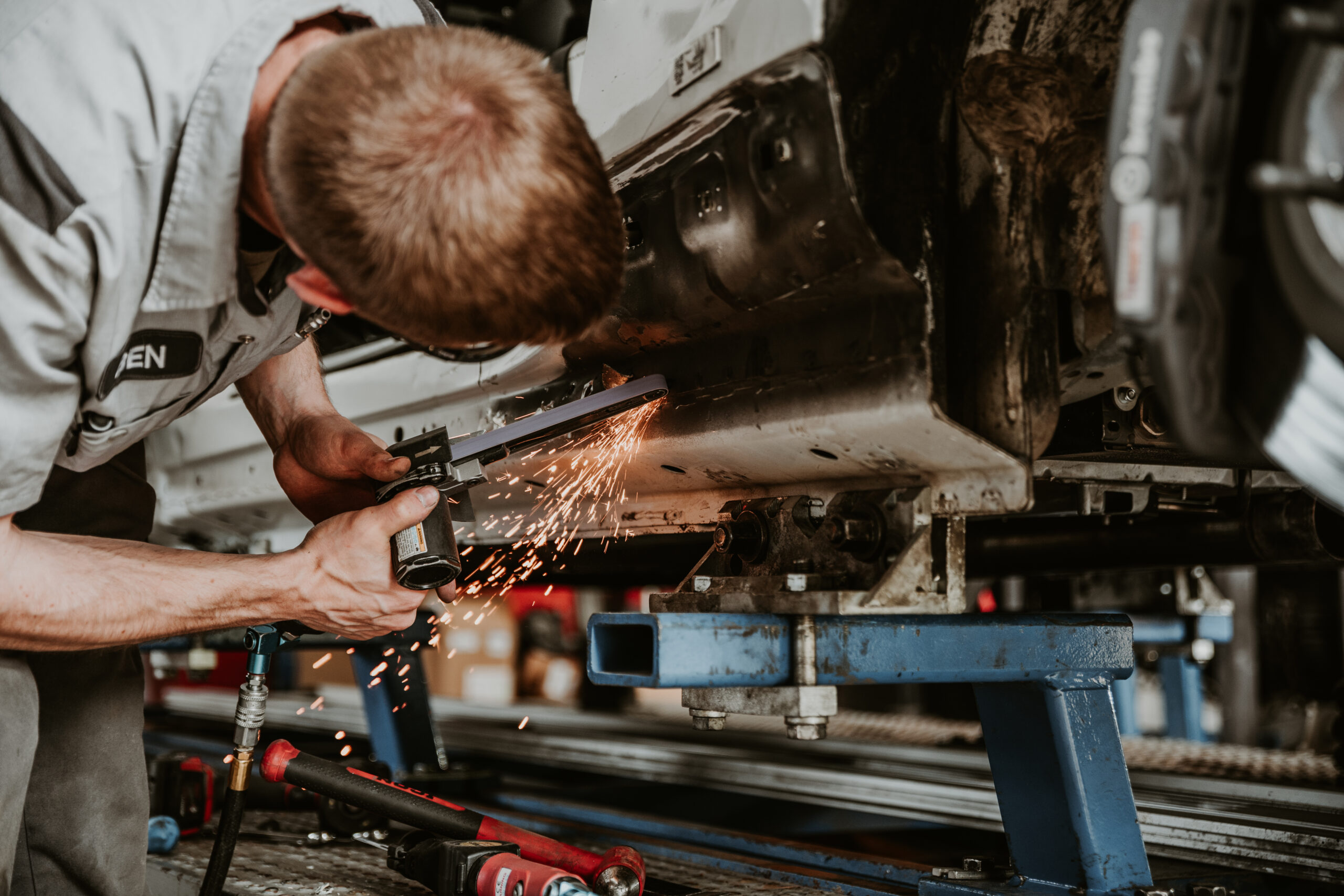
- Frame and structural damage: Straightening rails requires a frame machine and a 3D measuring system that can confirm dimensions are within factory tolerances, typically a few millimeters.
- Airbag or seatbelt deployment: Any crash that fires an airbag or seatbelt pretensioner requires replacing deployed parts and any related components the automaker specifies, followed by system scans.
- ADAS calibration: Cameras and radar require OEM targets, measuring equipment, and brand-specific software.
- Wheel alignment: Steering angle sensor resets and thrust angle corrections need a computerized four-wheel alignment.
- Red flags requiring immediate professional attention: Phantom braking, a pull to one side, an off-center steering wheel, any airbag or ADAS warning light, or doors that no longer close properly.
Common Collision Repair Mistakes to Avoid
1. Skipping the Pre-Repair Scan
What people do wrong: Repairs start without a diagnostic scan of the vehicle’s computer systems.
Why it’s a problem: Even minor collisions can set fault codes in airbag, steering angle, or ADAS modules without turning on a warning light. Without a pre-scan, those problems can go unnoticed and unrepaired.
The right approach: Ask for a pre-repair scan that documents every active diagnostic trouble code (DTC), and a post-repair scan confirming they’ve been resolved.
2. Replacing a Windshield Without Calibrating the Camera
What people do wrong: Using an installer who doesn’t calibrate, or glass with poor optical quality.
Why it’s a problem: The forward camera looks through the windshield. Distorted glass or an uncalibrated camera can misjudge lane position and following distance.
The right approach: Use OEM or OEM-equivalent glass and have the camera calibrated using the method the automaker requires: static, dynamic, or both.
3. Accepting Salvage or Uncertified Structural Parts
What people do wrong: Accepting used or non-certified aftermarket structural parts to lower the repair cost.
Why it’s a problem: Salvaged parts may carry hidden damage from a prior crash, and aftermarket structural parts may not be crash-tested to match the original.
The right approach: Ask for OEM parts on safety-critical structure, including rails, reinforcement bars, and intrusion beams.
4. Ignoring Suspension Damage
What people do wrong: Assuming the damage is cosmetic because the wheels look straight.
Why it’s a problem: A slightly bent control arm, knuckle, or subframe mount changes steering geometry, which can confuse stability control and lane-keeping systems.
The right approach: Ask for a four-wheel alignment printout showing caster, camber, toe, and thrust angle within factory specs.
Conclusion
A complete collision repair restores more than paint and panels. It returns your vehicle’s structure to factory specifications and makes sure your safety sensors see the road correctly. Before you pick up your vehicle, ask for pre- and post-repair scan reports, frame measurement printouts if structural work was done, and ADAS calibration reports.
Call us at (717) 627-3603 to ask how our technicians restore your vehicle’s safety from the frame up.
For drivers closer to Ephrata, Barry’s Paint Shop, our sister shop brings the same safety-first approach to every repair.
Serving Lititz, Brunnerville, Quentin, Manheim, Ephrata, Lancaster, Myerstown, Schaefferstown, Richland, Annville, Jonestown, Lebanon, and surrounding Lancaster and Lebanon County communities.
Frequently Asked Questions
What does structural integrity mean in collision repair?
Structural integrity means your vehicle’s unibody or frame keeps its original strength, rigidity, and ability to absorb crash energy. Maintaining it after a crash requires following the automaker’s repair procedures, using OEM-specified parts and materials, and using the joining methods the OEM calls for.
Why didn’t a warning light come on if my sensor is misaligned?
Most ADAS warnings are triggered by electrical faults, disconnected sensors, or a blocked view, not small aiming errors. Some systems can detect a large misalignment, but a sensor that’s slightly off may keep working with skewed information. A scan and the OEM-specified calibration or aiming check are the only reliable way to confirm it.
Does car insurance cover ADAS calibration and diagnostic scans?
Usually, when the repair itself is covered under your policy. Insurers generally pay for pre-scans, post-scans, and ADAS calibration when the automaker’s repair procedures call for them. Shops support these charges with scan reports and OEM procedure documentation. Coverage depends on your policy and claim, so confirm the details with your insurer.
Can a bad crumple zone repair affect airbag timing?
It can. Front crash sensors are mounted on or near the front structure, and the airbag module uses their readings of how quickly the vehicle slows to decide when to deploy. If a rail is improperly repaired and collapses differently than designed, the sensors may read a different crash pulse. That’s one reason automakers specify exact structural repair procedures.
Do I need ADAS calibration after a minor fender bender?
Often, yes. Many automakers require calibration whenever a sensor is removed, its mounting area is repaired, a bumper or windshield is replaced, or a wheel alignment is performed, even if the damage looked minor. Your vehicle’s specific repair procedures determine what’s required.
What is the difference between static and dynamic ADAS calibration?
Static calibration is done indoors with the vehicle parked on a level floor and targets or reflectors placed at exact OEM-specified positions. Dynamic calibration is done by driving the vehicle at a steady speed on well-marked roads with a scan tool connected. Some vehicles require both.
How do I confirm my body shop performed ADAS calibration?
Ask for the calibration report and the post-repair scan report. A reputable shop provides documentation showing the calibration was completed successfully, along with before-and-after diagnostic scans.
Related Resources
- After the Repair: How to Care for Your Vehicle in the First 30 Days After Collision Work
- Lititz Auto Body Repair Services: What to Expect From Start to Finish
- Contact Us
- Free Photo Estimate Tool
Sources:
- National Highway Traffic Safety Administration (NHTSA) — Driver Assistance Technologies overview.
- I-CAR — Collision repair training and OEM repair information resources.
- Insurance Institute for Highway Safety (IIHS) — Research on automatic emergency braking and rear-end crash reduction.